.png)
The most effective approach to age verification ecommerce is a layered flow: AI age estimation runs first as a fast, low-friction check; document plus selfie verification kicks in when the AI result is uncertain; and delivery-level adult-signature controls apply where the law or your carrier requires it. That three-layer structure balances conversion, auditability, and regulatory risk better than any single method alone. Your immediate next step is to audit your SKU list for restricted items and enable product-level gating at checkout for every restricted SKU before anything else.
Here is what that looks like in practice:
- Audit your SKUs first. Map every product to its applicable age threshold (21 for tobacco and vaping under FDA Tobacco 21 rules, 21 for alcohol in most states, 18+ for adult content and certain supplements).
- Gate at the product level, not just at account creation. A shopper who created an account at 18 may be buying a restricted item years later; checkout is the control point that matters.
- Use AI age estimation as your first line. It adds minimal friction for most customers and flags edge cases for documentary review.
- Require document plus selfie for flagged orders. This is the auditable fallback that regulators and payment underwriters actually want to see.
- Attach a signed outcome and Audit ID to every restricted order. Store the outcome, not the raw document image.
- Add delivery-level verification where required. The PACT Act and major carrier policies require adult-signature confirmation for vape and certain tobacco shipments.
Pro Tip: DavinciPay supports signed verification outcomes and Audit ID storage on the order record, which simplifies underwriting reviews and reduces your compliance exposure without requiring you to hold raw ID images on your own servers.
Key Takeaways
A layered age verification flow (AI estimation first, document plus selfie fallback, delivery controls where required) is the most effective approach for ecommerce merchants who need to balance conversion, auditability, and regulatory compliance.
| Point | Details |
|---|---|
| Start with a SKU audit | Map every restricted product to its age threshold and jurisdiction before choosing a verification method. |
| Gate at checkout, not just signup | Product-level checkout gating is the control point regulators and payment underwriters actually evaluate. |
| Store outcomes, not documents | Attach a signed outcome and Audit ID to every restricted order; never store raw ID images in your order system. |
| Test and monitor continuously | Track false pass rates, abandonment, and escalation rates; treat a deepfake spike as an incident requiring immediate review. |
| Davincipay for underwriting integration | Davincipay accepts signed verification outcomes and Audit IDs, reducing reserve requirements and speeding approval for restricted-product merchants. |
Table of Contents
- What is age verification for ecommerce, and why does your business need it?
- Which online age verification methods actually work at checkout?
- What regulatory basics do you need to check before choosing a solution?
- Where should you place age checks, and how do you integrate them?
- Should you build your own verification or use a third-party provider?
- How do you implement age verification step by step?
- Why does integrated age verification matter for payment underwriting?
- How do you handle cross-border age verification complexities?
- What most merchants get wrong about age verification
- Davincipay gives age-restricted merchants a payment foundation built for compliance
- Sources
What is age verification for ecommerce, and why does your business need it?
Age verification is the process of confirming that a buyer meets the minimum legal age for a product before the transaction completes. It is not the same as an age gate (a checkbox or a “click if you’re 18+” prompt) or a self-declaration (a date-of-birth field). Those are acknowledgment mechanisms. Auditable age verification produces a signed outcome tied to a real identity signal, whether that is a government-issued document, a biometric match, a database record, or a trusted digital wallet attestation.
Regulators and payment networks have largely stopped treating checkboxes as sufficient. Industry compliance guidance is explicit: merchants selling age-restricted products online need verifiable, auditable checks at checkout, not self-declaration.
Why this matters for your business:
- Regulatory fines and license risk. Tobacco, vaping, alcohol, gambling, adult content, and certain supplements each carry their own federal and state-level age requirements. Selling to a minor, even unknowingly, can trigger fines, license suspension, or carrier termination.
- Payment underwriting exposure. Acquiring banks and payment processors treat unverified age-restricted sales as elevated risk. Weak verification increases reserve requirements and can lead to account termination.
- Chargeback and fraud liability. Disputed transactions involving minors are difficult to defend without an audit trail. A signed verification outcome is your evidence.
- Marketplace and carrier requirements. UPS, FedEx, and USPS each have their own policies on adult-signature delivery for restricted products. Violating them can cut off your shipping options.
- Reputational risk. A single publicized sale to a minor can damage a brand far beyond any regulatory fine.
The CDC’s tracking of minimum legal sales ages shows that many jurisdictions have moved to 21 as the standard, aligning with public-health evidence on reduced initiation rates. That trend is not reversing.
Which online age verification methods actually work at checkout?
Each method sits at a different point on the friction-versus-assurance spectrum. The right choice depends on your product category, your regulatory obligations, and how much abandonment you can tolerate.
| Method category | How it works | Assurance level | Typical friction | Best role in a layered flow |
|---|---|---|---|---|
| Self-declaration / age gate | User enters DOB or clicks a checkbox | Very low | Near zero | Not sufficient alone; use only as a pre-filter |
| Credit-card signal | Card network infers adult status from card ownership | Low-medium | Zero | Useful secondary signal; not auditable on its own |
| Database / identity check | Name, DOB, address matched against credit or government records | Medium | Low | Good first-pass for returning customers with known data |
| AI age estimation | On-device or cloud model estimates age from a selfie | Medium-high | Low-medium | Ideal first line; fast and privacy-friendly when on-device |
| Document + selfie biometrics | OCR reads ID; liveness + face match confirms holder | High | Medium | Auditable fallback for flagged or high-value orders |
| Trusted proof-of-age wallet | Government-issued digital credential (e.g., EU Digital Identity Wallet) | Very high | Low once set up | Emerging; aligned with EU Age Verification Scheme |
| Delivery / adult-signature | Carrier confirms recipient age at the door | High (chain of custody) | Low for buyer | Required for PACT Act products; complements online check |
Industry analysis supports the AI-first, documentary-fallback model as the operational sweet spot for ecommerce merchants who need to balance conversion and auditability.
Pros and cons by method:
- AI age estimation: Fast, low-friction, privacy-friendly when processed on-device. The limitation is that it cannot produce a legally binding identity attestation on its own; it is a triage tool, not a final check.
- Document + selfie biometrics: Produces an auditable, signed outcome. Uses OCR, liveness detection, and biometric face matching. Deepfakes are a real operational threat here; any vendor you choose should include liveness and deepfake detection, not just face matching.
- Database checks: Low friction but dependent on data quality. Thin-file customers (young adults, recent immigrants) often fail database checks even when they are of age, which creates false negatives and abandonment.
- Delivery verification: Necessary for PACT Act-covered products and certain carrier policies. It does not replace online verification; it adds a chain-of-custody layer.
Pro Tip: For gaming payments compliance and age verification gaming contexts, AI estimation plus database cross-check is often enough for account creation. Reserve document checks for high-value transactions or when the AI result falls in a borderline age band.
What regulatory basics do you need to check before choosing a solution?
Think of your regulatory obligations as a floor, not a ceiling. The strictest jurisdiction you ship to sets your minimum standard, and you build up from there.
Federal requirements you cannot ignore:
- Tobacco and vaping (ENDS). The FDA’s final rule sets the federal minimum sales age at 21 and updated photographic ID verification thresholds under 21 CFR Part 1140. Online tobacco payments and online tobacco age verification are directly governed by this rule.
- PACT Act. Requires age verification at the point of sale and adult-signature delivery for cigarettes, smokeless tobacco, and ENDS. Carrier compliance is mandatory.
- COPPA / FTC. If your verification flow collects data from users who might be under 13, COPPA applies to that data. Design your flow to avoid collecting children’s data at all; if a user fails an age check, stop the flow before collecting further personal information.
State-level patchwork:
State laws vary significantly for alcohol, cannabis, and adult content. Some states require specific verification methods or retention periods. Map your shipping destinations against state requirements for every restricted SKU category you sell.
What you must do before going live:
- Map every SKU to its applicable age threshold and jurisdiction.
- Document your verification method and the auditable proof it produces (Audit ID, signed outcome, event log).
- Confirm delivery controls where required (PACT Act, carrier policies for vaping and alcohol).
- Review your data retention policy. Store the minimum necessary: the signed outcome and Audit ID, not the raw document image.
- Check CCPA/CPRA obligations if you serve California customers. Verification data is sensitive personal information under California law.
Pro Tip: Identify the strictest jurisdiction you ship to and design your verification flow to meet or escalate to that standard. It is far easier to build one compliant flow than to maintain separate flows per state.
Where should you place age checks, and how do you integrate them?
Placement matters as much as method. Gating only at account creation is one of the most common and costly mistakes in age verification ecommerce. A customer verified at 18 during signup may return years later to buy a newly listed restricted product. Checkout is the control point that counts.
Recommended placement patterns:
- Product-level gating. Flag restricted SKUs in your product catalog. When a restricted item enters the cart, trigger the verification flow before checkout proceeds.
- Cart-level gating. If your catalog is complex, a cart-level check that scans for any restricted SKU before checkout is a reliable fallback.
- Checkout-blocking for restricted SKUs. The payment step should not complete until a signed verification outcome is attached to the order.
- Delivery verification as a separate event. Adult-signature confirmation at delivery is logged separately and attached to the shipment record, not the checkout record.
Platform integration notes:
- Shopify. Age verification apps in the Shopify App Store integrate via checkout extensions. Look for apps that store only the Audit ID and signed outcome on the order metafield, not raw document images.
- WooCommerce. Plugin-based integrations are common. API-based integrations give you more control over where verification data is stored and how it is passed to your order management system.
- Magento / Adobe Commerce. Custom module or API integration is typical. Tokenization of returning-user verification outcomes reduces friction on repeat purchases.
- Custom platforms. Use a verification provider’s REST API or SDK. Pass the signed outcome and Audit ID to your order record at the point of payment authorization.
Product-level gating with Audit ID storage on the order record is the privacy-first pattern regulators and payment underwriters prefer. It keeps restricted orders auditable without requiring you to maintain a database of identity documents.
UX best practices to reduce abandonment:
- Show clear, plain-language guidance when a document check is required. Customers who understand why they are being asked convert at higher rates.
- Offer a fallback contact or manual review path for customers whose documents fail automated checks (poor image quality, unusual ID formats).
- For returning verified customers, use a token or signed outcome stored on their account to skip re-verification on subsequent purchases of the same product category.
Pro Tip: Store only the Audit ID and signed outcome on the order record. Never store raw ID images or passport scans in your order management system or CRM. This single practice reduces your CCPA/CPRA exposure and simplifies any regulatory audit.
Should you build your own verification or use a third-party provider?
For most ecommerce merchants, a third-party provider is the right call. Building your own verification stack requires maintaining OCR models, liveness detection, biometric matching, deepfake defenses, and audit-log infrastructure. That is a significant ongoing engineering commitment for a function that is not your core business.
Decision checklist:
- Accuracy (false pass rate). Ask every vendor for their false pass rate at your specific age threshold. A vendor who cannot give you this number is not ready for a regulated use case.
- Latency. Verification that takes more than a few seconds materially increases abandonment. On-device AI models are faster than cloud round-trips.
- Data minimization. Does the vendor process biometrics on-device or in the cloud? On-device processing reduces GDPR and CCPA exposure. The EU’s privacy-preserving blueprint explicitly promotes on-device and ephemeral-token architectures.
- Audit logs and Audit IDs. Every verification event should produce a signed, timestamped outcome with a unique Audit ID you can attach to the order record.
- Returning-user tokens. A good vendor issues a token after first verification so repeat customers skip the full flow.
- Geographic coverage. Confirm the vendor’s document library covers the ID types your customers actually present.
Red flags when evaluating vendors:
- Vague accuracy claims (“industry-leading”) with no published false pass rate data.
- No Audit ID or signed outcome in the verification response.
- Permanent storage of full ID images on the vendor’s servers with no deletion schedule.
- No liveness or deepfake detection in the document plus selfie flow.
- No delivery attestation option for PACT Act products.
When DIY makes sense: If you have a niche verification source (a proprietary age database, a government data-sharing agreement) or need tight control over the verification architecture for regulatory reasons, building in-house is defensible. For most merchants, it is not worth the cost.
Vendor question checklist:
- What is your false pass rate at the 21-year threshold for tobacco and vaping products?
- Is biometric processing done on-device, in the cloud, or both? Where is liveness detection performed?
- What is your retention policy for document images and biometric data? When are they deleted?
- What does your Audit ID format look like, and how do we attach it to our order record?
- Do you support delivery attestation integration for PACT Act-covered products?
How do you implement age verification step by step?
Implementation checklist:
- Audit your SKU catalog and tag every restricted product with its applicable age threshold and jurisdiction.
- Map regulatory obligations by product category and shipping destination.
- Select your verification method and vendor based on the decision checklist above.
- Integrate via API, SDK, or platform plugin. Confirm the signed outcome and Audit ID are passed to your order record at payment authorization.
- Run QA with test orders across all restricted SKU categories. Test edge cases: borderline ages, unusual ID formats, poor image quality.
- Document your verification process for compliance purposes. This document is what you hand to a regulator or payment underwriter during an audit.
- Train customer service staff on how to handle verification failures, appeals, and manual review requests.
- Set up monitoring: track false pass rates, false fail rates, abandonment at the verification step, and escalation rates to documentary checks.
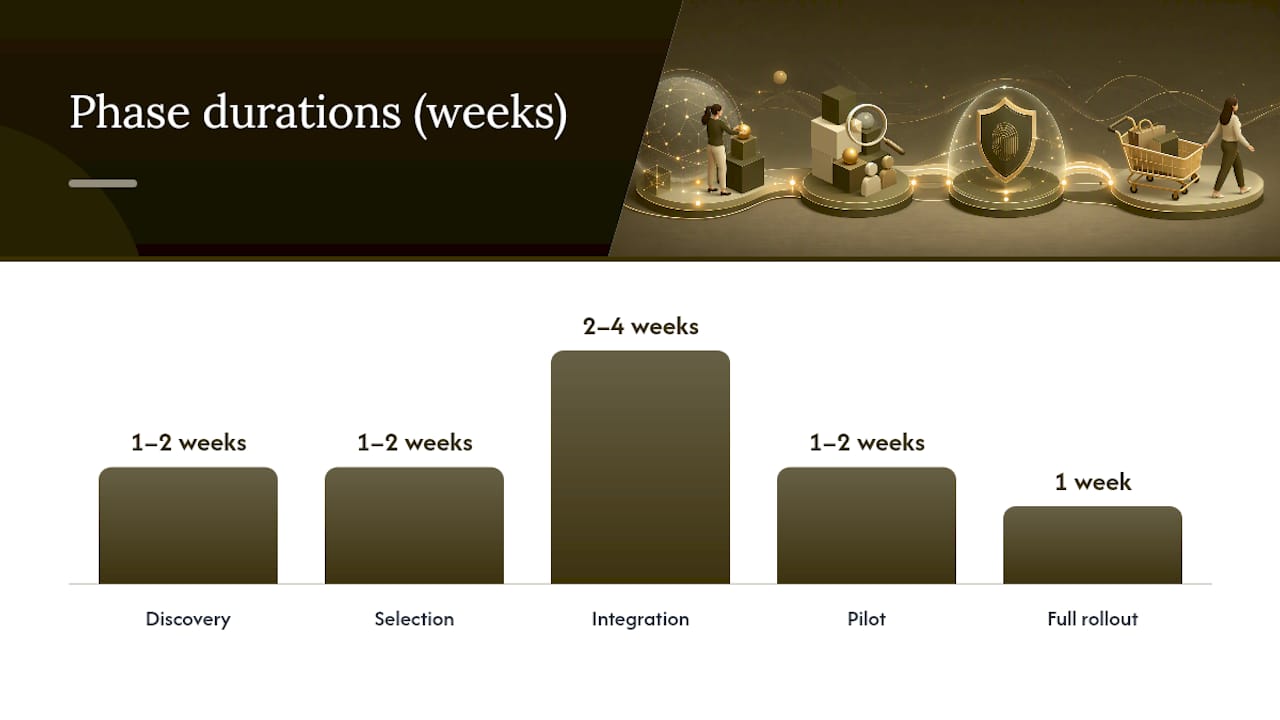
Typical implementation timeline:
| Phase | Activities | Estimated duration |
|---|---|---|
| Discovery | SKU audit, regulatory mapping, vendor shortlist | 1–2 weeks |
| Selection | Vendor evaluation, contract, data processing agreement | 1–2 weeks |
| Integration | API/SDK/plugin build, order-record configuration | 2–4 weeks |
| Pilot | QA, test orders, staff training, privacy policy update | 1–2 weeks |
| Full rollout | Go-live, monitoring setup, incident response plan | 1 week |
Cost factors to budget for:
- Per-transaction verification fees (document checks cost more than AI estimation).
- Monthly platform or app fees from your verification vendor.
- Development and integration time (higher for custom platforms than Shopify or WooCommerce).
- Delivery-level verification costs (carrier adult-signature fees per shipment).
- Ongoing monitoring and periodic revalidation to catch model drift or fraud spikes.
Operational monitoring should include false-pass and false-fail metrics, escalation rates, and periodic revalidation. If your deepfake detection flags a spike, treat it as an incident and investigate before it becomes a chargeback or regulatory problem. For high-risk merchants concerned about fraud exposure, a digital forensics partner can support incident response when verification fraud is suspected.
Why does integrated age verification matter for payment underwriting?
Payment underwriters look at your verification infrastructure the same way they look at your fraud controls: as evidence of how seriously you manage risk. A merchant selling tobacco, vaping products, or adult content with no auditable verification record is a liability. One with signed outcomes, Audit IDs, and event logs attached to every restricted order is a manageable account.
Signed verification outcomes reduce underwriting friction in two concrete ways. First, they give the acquiring bank evidence that you checked age before processing the transaction, which limits the bank’s exposure in a regulatory inquiry. Second, they make chargeback investigations faster. When a disputed transaction involves a restricted product, the Audit ID attached to the order record is your first line of defense.
Davincipay is built to accept signed verification outcomes and store verification metadata on the order record without holding raw ID images. That architecture matters for nutraceutical and supplement merchants and other regulated sellers who need payment infrastructure that understands their compliance environment, not just their transaction volume.
Pro Tip: When you apply for a merchant account with a payment processor for a restricted-product category, include your verification flow documentation in your underwriting package. Processors who see a documented, auditable verification process approve accounts faster and set lower reserve requirements.
How do you handle cross-border age verification complexities?
Selling across borders multiplies your compliance surface. A flow that meets U.S. federal requirements may not satisfy a Canadian province, a UK regulator, or an EU member state.
The core challenge: Age thresholds, acceptable verification methods, and data-handling rules all vary by jurisdiction. The EU’s Age Verification Scheme promotes privacy-preserving, interoperable proof-of-age solutions tied to Digital Identity Wallets. That is a materially different architecture from U.S. database-check approaches. A document plus selfie flow that is compliant in the U.S. may still require a separate data processing agreement and a different retention policy to comply with GDPR in the EU.
Practical steps for cross-border merchants:
- Geo-route your verification logic. Detect the customer’s shipping destination and apply the verification method and threshold required for that jurisdiction. A customer shipping to a U.S. state with a 21 MLSA for tobacco gets a different flow than one shipping to a country with an 18 threshold.
- Use a vendor with broad document coverage. International customers present non-U.S. IDs. Your verification vendor’s document library needs to cover the countries you ship to.
- Separate data processing by region. EU customer verification data should be processed and stored in EU-compliant infrastructure. Do not route EU biometric data through U.S.-only cloud infrastructure without a valid legal basis.
- Review carrier restrictions by country. Some products (vaping, certain supplements) face import restrictions or carrier refusals in specific markets. Age verification does not override import law.
- Keep jurisdiction-specific audit logs. If a regulator in a specific country requests records, you need to produce records that meet that country’s format and retention requirements.
For online identity protection best practices that apply across borders, the principle is consistent: collect the minimum data needed, process it as close to the user as possible, and delete it as soon as the verification event is complete.
What most merchants get wrong about age verification
The single most common mistake is treating age verification as a one-time event at account creation. It is not. Verification needs to happen at the point of restricted-product purchase, every time, because the product in the cart is what triggers the legal obligation, not the existence of an account.
The second most common mistake is storing too much data. Merchants who hold raw passport scans or full ID images in their order management system are creating a privacy liability that far exceeds the compliance benefit. Regulators increasingly want signed outcomes and Audit IDs, not raw documents. Store the outcome, not the source material.
A few non-obvious trade-offs worth knowing:
- Threshold tuning matters. If you set your AI age-estimation threshold too conservatively (flagging everyone who looks under 30 for a document check on a 21+ product), you will see abandonment spike among legitimate customers in their mid-20s. Tune thresholds by product risk and geography, not by a single global setting.
- Returning-user tokens are underused. Most merchants re-verify customers on every purchase. A signed token stored on the customer account, with a reasonable expiration period, reduces friction for repeat buyers without compromising auditability.
- Customer service needs a clear escalation path. When verification fails for a legitimate customer (poor lighting, unusual ID format, name mismatch), they need a fast, human-reviewed appeal path. A customer who cannot complete a purchase and cannot reach a human will dispute the charge or leave permanently.
Davincipay gives age-restricted merchants a payment foundation built for compliance
High-risk merchants selling tobacco, vaping products, adult content, supplements, or gaming-related goods need more than a payment processor that tolerates their category. They need one that understands the verification infrastructure behind it.

Davincipay supports signed verification outcomes and Audit ID storage on the order record, so your compliance documentation lives where your payment data lives. The platform integrates with common ecommerce stacks and works with merchants across regulated verticals including supplements, nutraceuticals, and digital goods. Underwriting at Davincipay recognizes compliant verification as a risk-reducing factor, which means merchants with documented age-check flows typically move through approval faster and face lower reserve requirements.
To get started, apply for a merchant account and have your SKU list, target jurisdictions, and expected monthly volume ready. The underwriting team will review your verification setup as part of the approval process.
Sources
These sources cover the regulatory text, technical blueprints, and operational guidance merchants should consult when designing or auditing their verification flows.
- Prohibition of Sale of Tobacco Products to Persons Younger Than 21 Years of Age
- Federalregister
- Minimum legal sales age — CDC State Tobacco Activities Tracking and Evaluation (STATE) System
This article is general information, not a substitute for advice from a qualified lawyer. Consult a qualified legal professional about your own circumstances before acting on anything here.


.webp)
