.png)
The best affiliate payment partner program for high-risk U.S. ecommerce is a compliant, automated mass-payout system that supports Pay Per Sale (PPS) and Revenue Share (RevShare), collects W-9/W-8 forms at onboarding, routes payments via ACH, wire, or digital wallet, and syncs with your ERP for clean reconciliation. If you’re running a supplement brand, telehealth operation, or subscription commerce business, you need a partner built for your compliance reality, not a generic SaaS tool.
Three things your program must handle from day one:
- Compliance: Collect and validate W-9 forms for U.S. affiliates and the appropriate W-8 series for non-U.S. affiliates before the first payout clears.
- Payout rails: Support domestic ACH (1–3 business days), wire transfers (1–2 business days), and digital wallets, with transparent fee structures for each.
- Automation and accounting sync: Batch payouts, transaction-level exports, and ERP integration (NetSuite or QuickBooks) to close your books without spreadsheet work.
Start your vendor evaluation now by requesting a pilot with Davincipay and running two payout cycles before committing to full rollout.
Table of Contents
- Which affiliate commission models work best for high-risk merchants?
- What payout rails should you offer, and what do they cost?
- U.S. tax forms and compliance requirements for affiliate payouts
- Why automation and ERP integration are non-negotiable at scale
- How to design an affiliate onboarding flow that prevents compliance gaps
- Risk controls every high-risk affiliate program needs
- Launch checklist: how to implement your affiliate payment program
- How Davincipay supports affiliate payment programs for high-risk merchants
- Total cost considerations: hidden fees and setup charges
- Key Takeaways
- What the conventional wisdom on affiliate programs gets wrong
- Davincipay handles the compliance complexity so you can focus on growth
- Useful sources and further reading
Which affiliate commission models work best for high-risk merchants?
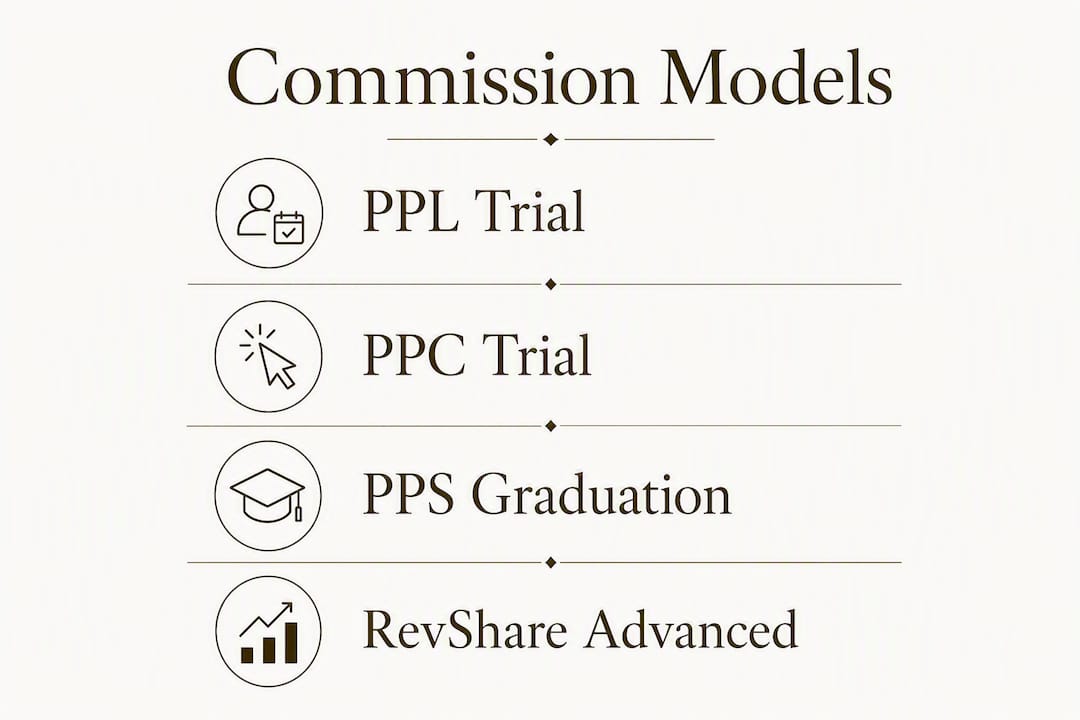
PPS and RevShare are the two models that align most directly with high-risk merchant economics. Here’s how each model works and where it fits:
- Pay Per Sale (PPS): You pay a fixed amount or percentage when a confirmed sale clears. Low fraud risk, easy to audit, and straightforward to reconcile. Best for supplement, nutraceutical, and digital goods merchants.
- Revenue Share (RevShare): You pay a recurring percentage of the customer’s lifetime revenue. Ideal for subscription merchants and telehealth platforms where customer LTV is the real metric. Requires recurring tracking and affects your payout cadence and reserve calculations.
- Pay Per Lead (PPL): You pay for a qualified lead, not a sale. Useful for testing new affiliate partners before committing to PPS rates, but carries higher fraud exposure in high-risk verticals.
- Pay Per Click (PPC): You pay per click generated. Rarely the primary model for high-risk programs, but works as a complementary structure for brand awareness campaigns with vetted partners.
RevShare demands more from your payout infrastructure. You need recurring attribution tracking, rolling reserve calculations, and the ability to claw back commissions when subscriptions cancel or charge back.
Pro Tip: Use PPL or PPC as a 30-day trial structure for new affiliates before graduating them to PPS or RevShare. It limits your financial exposure while you validate traffic quality and conversion rates.
What payout rails should you offer, and what do they cost?
Your choice of payout rail affects partner satisfaction, your operating cost, and your compliance exposure. Allowing affiliates to choose their preferred rail during onboarding materially increases program participation and retention.

| Rail | Settlement Time | Typical Cost to Business | Best Use Case |
|---|---|---|---|
| Domestic ACH with a short settlement time | Low (cents per transaction) | U.S. affiliates, standard payouts | |
| Global ACH / eCheck | 2–5 business days | Low to moderate | International affiliates in supported countries |
| Wire transfer with faster settlement times | Higher ($15–$50+ per wire) | Urgent or large-amount payouts | |
| Digital wallets | Instant to 1 day | Variable (wallet withdrawal fees apply) | Affiliates preferring speed over cost |
Wire transfers are useful for large, time-sensitive payments, but the per-transaction cost makes them impractical as a default rail. ACH is the right default for U.S. affiliates. For international partners, mass payment platforms often route through local rails to bypass SWIFT and reduce correspondent bank fees.
Watch for hidden costs in your contracts: correspondent bank fees on international wires, wallet withdrawal fees passed to affiliates, and FX conversion spreads on multi-currency payouts. Require your payment partner to itemize these before signing.
Payout rail selection is a retention decision as much as a cost decision. Affiliates who receive payments on their preferred rail with predictable timing stay active longer and promote more consistently.
U.S. tax forms and compliance requirements for affiliate payouts
The IRS requires you to collect a W-9 from every U.S. affiliate and the appropriate W-8 series form from every non-U.S. affiliate. Missing or invalid forms expose you to reporting liability and can delay payouts indefinitely.
- Collect W-9 (U.S. affiliates) and W-8BEN or W-8BEN-E (non-U.S. individuals and entities) before the first payout.
- Use automated TIN matching to validate tax identification numbers in real time during onboarding, not after the fact.
- Gate payouts: no valid tax form, no payment. Many programs set minimum payout thresholds of $50–$500 depending on rail and hold funds until forms are verified.
- File 1099-NEC forms for U.S. affiliates who meet income reporting requirements in a calendar year. Non-U.S. affiliates may require withholding depending on their W-8 classification and applicable tax treaties.
Automating W-9/W-8 collection is a legal safeguard, not just an efficiency gain. As the program operator, you bear responsibility for validating payee identities and accurate tax reporting. A missed form is not an administrative inconvenience — it is a compliance gap that can trigger IRS penalties and payout disputes.
Why automation and ERP integration are non-negotiable at scale
Manual payout processing creates accounting errors and administrative overhead that compound quickly once you have more than a few dozen active affiliates. Automated mass-payment platforms consolidate debits and provide transaction-level exports that sync directly to ERPs, shortening month-end close and lowering per-payment cost.
Integration capabilities to require from any payout partner:
- Bulk batch debit processing with per-transaction reporting exports.
- ERP sync to NetSuite or QuickBooks with commission entries mapped to the correct ledger accounts.
- REST API endpoints for payment initiation, status queries, and affiliate data management.
- Real-time tax form validation triggered at onboarding and re-validated before each payout cycle.
- OFAC/sanctions screening on every payee before funds move.
- Consolidated bulk debit plus line-level reconciliation so your finance team sees one bank debit but can reconcile individual commission expenses automatically.
For your accounting team, the ideal export includes: affiliate ID, commission amount, payout rail, settlement date, tax form status, and the corresponding ledger account code. If your payout partner cannot produce that file, reconciliation becomes a manual project every month. For merchants who want to offload AP workflows entirely, outsourced invoicing support can complement your mass-payout infrastructure.
Pro Tip: Map commission expense entries to a dedicated ledger account before your first payout cycle. Retroactively reclassifying hundreds of transactions is far more expensive than setting the mapping correctly on day one.
How to design an affiliate onboarding flow that prevents compliance gaps
A structured onboarding workflow stops compliance problems before they start. Here is the sequence that works for high-risk programs:
- Invite and register: Send a branded registration link. Collect business name, contact details, and promotional channel information.
- Tax form upload and validation: Require W-9 or W-8 completion before the affiliate can proceed. Run automated TIN matching immediately.
- Payment rail selection: Let affiliates choose their preferred payout method. Single-rail onboarding means affiliates connect once and receive consolidated payouts across all programs on the platform.
- KYC/KYB checks: For high-risk partners or those receiving above a defined threshold, run identity verification (individuals) or business verification (entities). This is non-negotiable for regulated verticals like telehealth and CBD.
- Test payout: Send a small verification payment before activating the affiliate for live commissions.
- Live payouts: Release commissions on your defined schedule after the hold period clears.
Hold periods matter. A 15–30 day grace window after a sale gives you time to process refunds and cancellations before commissions are released. This protects your reserves and reduces clawback disputes.
Pro Tip: Offer at least three payout rail options at onboarding. Affiliates who cannot use their preferred method often delay completing setup, which stalls your program launch.
Minimum data required per affiliate type:
- Individual: Legal name, address, SSN or ITIN (via W-9), preferred payout rail and account details.
- Business entity: Legal business name, EIN (via W-9 or W-8BEN-E), authorized signer, and bank or wallet details.
Risk controls every high-risk affiliate program needs
High-risk programs attract higher-quality fraud attempts. These are the risks that matter most and the controls that address them:
| Risk Type | Potential Impact | Mitigation |
|---|---|---|
| Affiliate fraud (fake conversions) | Inflated commissions, chargeback exposure | Fraud scoring, pattern detection, KYC enforcement |
| Click/lead fraud | Wasted PPL/PPC spend | Traffic quality filters, conversion rate thresholds |
| Chargeback exposure | Reserve draws, processor penalties | Hold periods, clawback clauses, rolling reserves |
| Identity spoofing | Fraudulent payouts, sanctions violations | KYB/KYC verification, OFAC screening |
| Compliance gaps | IRS penalties, payout delays | Automated tax form validation, gated payouts |
Practical controls to implement:
- Set rolling reserves (typically 5–10% of commission volume) to cover potential chargebacks and clawbacks.
- Include explicit clawback clauses in your affiliate agreement covering chargebacks, refunds, and fraudulent conversions.
- Run reconciliation checks after every payout cycle to catch orphan payouts (commissions with no matching conversion record) and unusual volume spikes.
- Require KYC for any affiliate earning above a defined monthly threshold, regardless of how long they have been in the program.
Launch checklist: how to implement your affiliate payment program
Use this sequence to go from planning to live payouts without compliance gaps.
- Define your commission model (PPS, RevShare, or hybrid) and set rates by affiliate tier.
- Set your payout schedule (weekly, bi-weekly, or NET-30) and minimum payout thresholds.
- Select payout rails and confirm fee structures with your payment partner in writing.
- Build your onboarding flow with mandatory tax form capture and TIN validation.
- Enable fraud scoring, KYC/KYB checks, and OFAC screening before accepting the first affiliate.
- Integrate your payout platform with your ERP (NetSuite or QuickBooks) and confirm the ledger mapping.
- Run a pilot with a small cohort (10–20 affiliates) through two full payout cycles.
- Validate reconciliation completeness, tax validation pass rate, and dispute rate before scaling.
Go/no-go criteria before full rollout: reconciliation matches 100% of transactions, tax form validation passes for all active affiliates, and your dispute rate stays below your processor’s threshold.
How Davincipay supports affiliate payment programs for high-risk merchants
Davincipay is built specifically for the compliance and operational demands that high-risk and regulated ecommerce merchants face. Here is how Davincipay’s capabilities map to the requirements in this guide:
- Mass payouts with multiple rails: ACH, wire, and digital wallet support with configurable payout schedules.
- Automated W-9/W-8 collection and validation: Real-time tax form collection and TIN matching during affiliate onboarding, with gated payouts until forms are verified.
- KYC/KYB support: Identity and business verification for high-risk affiliate partners, including telehealth and nutraceutical verticals.
- Chargeback mitigation: Built-in chargeback management tools and reserve structures designed for high-risk acquiring relationships.
- ERP integrations: Transaction-level reporting exports and accounting sync for clean reconciliation. See how it works for integration details.
The typical onboarding timeline runs 1–2 weeks from application to first test payout. Start by applying for a merchant account, then run the pilot checklist above with Davincipay’s team before activating your full affiliate network.
Total cost considerations: hidden fees and setup charges
The sticker price of a payout platform rarely reflects the true cost. Budget for these line items before you sign:
Setup and monthly fees: Most platforms charge a setup fee plus a monthly platform fee. Confirm what is included and what triggers overage charges.
Per-transaction fees: ACH transactions typically cost cents per payment. Wire transfers run $15–$50 or more per transaction. Digital wallet fees vary by provider and withdrawal method.
Tax form and compliance fees: Some platforms charge per W-9/W-8 collected or per 1099 filed. At scale, these add up quickly.
FX and conversion fees: International payouts carry FX spreads. Require your partner to disclose the spread in basis points, not just the nominal exchange rate.
Reserve requirements: High-risk programs may require a cash reserve held by the processor. This is not a fee, but it is a cash flow consideration. For merchants who want to offload disbursement workflows, bill pay services can handle the operational side while your payout platform handles compliance.
Chargeback and dispute fees: Processors charge per chargeback received. High-risk programs with elevated dispute rates can see these fees compound fast. Factor your expected dispute rate into your total cost model before selecting a partner.
Key Takeaways
A compliant, automated affiliate payment partner program for high-risk U.S. ecommerce requires W-9/W-8 enforcement, multi-rail payout support, ERP integration, and fraud controls built in from day one.
| Point | Details |
|---|---|
| Tax form enforcement | Collect and validate W-9 (U.S.) and W-8 series (non-U.S.) before releasing any payout. |
| Payout rail selection | Default to ACH for U.S. affiliates; offer wire and wallet options to improve partner retention. |
| Automation and ERP sync | Require bulk batch processing and NetSuite/QuickBooks integration to close books without manual work. |
| Risk and reserve controls | Set rolling reserves, enforce hold periods, and include clawback clauses in every affiliate agreement. |
| Davincipay fit | Davincipay provides mass payouts, automated tax form collection, chargeback mitigation, and ERP reporting for high-risk merchants. |
What the conventional wisdom on affiliate programs gets wrong
Most guides treat affiliate program setup as a marketing problem. For high-risk merchants, it is a compliance and payments infrastructure problem first. The commission model you choose matters far less than whether your payout system can enforce tax collection, survive a chargeback spike, and reconcile cleanly at month-end.
The operators who run into trouble are not the ones who picked the wrong RevShare rate. They are the ones who launched with a generic payout tool, skipped W-8 collection for international affiliates, and discovered the gap when the IRS sent a notice or a processor froze their account.
The other underestimated factor is payout rail choice as a retention lever. Affiliates who cannot receive payments on their preferred method quietly stop promoting. You will not see a resignation email. You will just see declining conversion volume from partners you thought were active.
Build the compliance and payout infrastructure correctly before you recruit a single affiliate. The program scales easily after that. Getting it right after the fact is expensive and disruptive.
Davincipay handles the compliance complexity so you can focus on growth
High-risk merchants running affiliate programs need a payment partner who understands acquiring relationships, chargeback exposure, and tax reporting obligations, not just commission tracking. Davincipay provides exactly that: mass payouts across multiple rails, automated W-9/W-8 collection, KYC support, chargeback mitigation, and ERP integration built for supplement brands, telehealth operators, nutraceutical merchants, and other regulated ecommerce businesses.

The pilot process is straightforward. Apply, configure your payout rules, onboard a small affiliate cohort, and run two payout cycles to validate reconciliation and tax reporting before scaling. Apply now to start your pilot and get your affiliate payment program built on infrastructure that holds up under scrutiny.
Useful sources and further reading
- IRS — W-9 and W-8 form requirements: Primary authority on tax form collection obligations for U.S. payers, including affiliate program operators.
- Tipalti — Affiliate payments guide: Detailed reference on payout rails, timing, mass-payment automation, and ERP reconciliation for affiliate programs.
- Spendflo — Affiliate payments blog: Covers FX handling, local-rail routing, and hidden fee structures for international affiliate payouts.
- Rekomi — How affiliates get paid: Explains single-rail onboarding, payout rail selection, and the retention impact of payment flexibility.
- ExoAffiliate — Payment terms and frequency: Reference for minimum payout thresholds and payout gating policies across common affiliate program structures.
This guide provides general information about affiliate payment program design and compliance practices. It is not legal, tax, or financial advice. Confirm current IRS requirements and processor terms with a qualified professional for your specific situation.


.webp)
