.png)
For most subscription businesses, ACH beats credit cards on cost while cards win on speed and dispute protection. The trade-offs come down to three things: transaction fees, how fast funds settle, and how much exposure you carry when a customer disputes a charge. ACH also demands stricter authorization recordkeeping under federal rules, so the cheaper rail only pays off if your compliance process is solid.
TL;DR:
- ACH payments generally cost about $0.40 per transaction, making them more economical than credit cards once the average order exceeds $25 to $30.
- Standard ACH settlement takes one to three business days, whereas Same-Day ACH can settle within the banking day for transactions up to $1 million.
- Card disputes result in charges regardless of the outcome, while ACH returns can be initiated faster but pose claims for up to two years for consumer accounts.
- Compliance requires signed or authenticated authorizations with clear billing details, which merchants often overlook and risk disputes if not properly documented.
- For high-value, recurring subscriptions, ACH is typically cheaper and preferable, whereas low-ticket, high-churn products benefit from faster card authorization and dispute resolution.
Table of Contents
- Fees and pricing: how to compare per-transaction cost and the break-even for subscriptions
- Settlement timing and cash flow: authorization vs settlement and Same-Day ACH
- Disputes, returns, and chargeback exposure: how risk differs on each rail
- Compliance for recurring ACH: Regulation E, NACHA authorizations, and operational checklist
- Operational trade-offs: retries, tokenization, customer experience, and hybrid strategies
- Decision framework: choose ACH, cards, or hybrid based on AOV, churn tolerance, refund risk, and compliance capacity
- Lessons from working with subscription merchants
- How DavinciPay supports subscription merchants
- FAQ
- Sources
Fees and pricing: how to compare per-transaction cost and the break-even for subscriptions
On a $50 monthly subscription, that’s roughly $0.75 to $1.50 per billing cycle, every cycle, for the life of the customer.

ACH works differently. Processors typically charge a flat fee per transaction or a low percentage with a cap, and industry data put the median internal cost of processing an ACH payment at around $0.40. That $0.40 median cost means ACH often wins decisively once your average order value climbs past $25 to $30, since card fees scale with price and ACH fees generally do not.
A few line items change the math:
- Return fees apply when an ACH debit fails, often $2 to $5 per return depending on your processor.
- Chargeback fees on card disputes can run $15 to $25 regardless of outcome.
- Same-Day ACH and expedited card settlement both carry a small premium over standard timing.
Run the numbers on your own average order value before assuming one rail is cheaper. High-ticket subscriptions (coaching, software, bulk supplements) tend to favor ACH; low-ticket digital subscriptions often do better on cards, where fraud tools and instant authorization reduce friction.
Settlement timing and cash flow: authorization vs settlement and Same-Day ACH
Credit card authorization happens in seconds, and funds typically land in your account within one to two business days. ACH works on a different clock: standard transactions usually settle in one to three business days, with the debit confirmed only after it clears the customer’s bank.
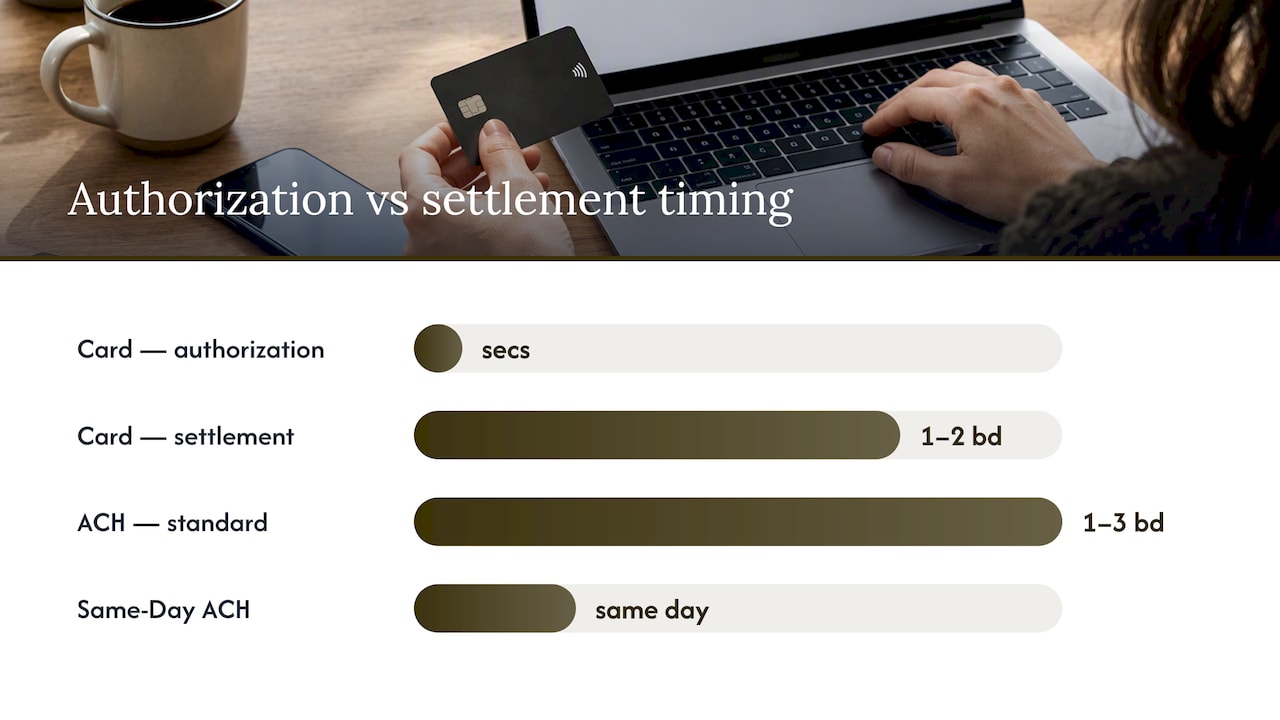
Same-Day ACH narrows that gap. Under Nacha rules, eligible entries up to $1 million can settle within the same banking day, subject to program limits and bank cutoff times.
That timing difference matters for:
- Working capital, since card revenue is available to spend or reinvest a day or two sooner than standard ACH.
- Refund processing, where card reversals post faster than ACH reversals in most cases.
- Payroll and vendor payments, where Same-Day ACH can replace a wire transfer for urgent, time-sensitive transfers.
For subscription merchants running tight cash cycles, the practical fix is simple: push for Same-Day ACH on your processor agreement rather than defaulting to standard settlement.
Disputes, returns, and chargeback exposure: how risk differs on each rail
Cards and ACH handle disputes through entirely different systems, and the gap in merchant exposure is significant. Card chargebacks go through the card network’s dispute process, with reason codes covering fraud, non-receipt, and “not as described,” and your business bears the fee whether you win or lose.
ACH returns run through Nacha’s reversal and enforcement rules, using codes like R11 for unauthorized entries. The return process is usually faster to initiate but carries a longer tail: warranty claims against unauthorized consumer debits can be made up to two years after settlement for consumer accounts, compared with one year for non-consumer accounts.
- Card disputes tend to resolve in weeks but hit you with a fee on every case, win or lose.
- ACH returns settle faster operationally but expose you to claims much further out.
- Clear authorization language and dated consent records are your strongest defense on either rail.
Pro Tip: Keep a time-stamped copy of every signed authorization and attach it automatically to any dispute response, you’ll resolve representment faster and lose fewer cases you should win. A practical playbook for chargeback representment walks through the evidence structure that tends to hold up.
Compliance for recurring ACH: Regulation E, NACHA authorizations, and operational checklist
Recurring ACH debits from consumer accounts fall under Regulation E, and the CFPB’s compliance bulletin is explicit: preauthorized transfers require a writing signed or similarly authenticated by the consumer, and you must provide a copy of that authorization. This single requirement, a signed or authenticated authorization plus a consumer copy, is the most commonly missed step merchants run into during disputes.
A working checklist for subscription merchants:
- Capture authorization in writing, whether on paper or through an electronic signature compliant with the E-Sign Act.
- State the dollar amount, frequency, and start date of the recurring debit clearly in the authorization text.
- Provide the customer a copy immediately, by email or downloadable receipt, not just a confirmation screen.
- Store authorization records for at least the length of Nacha’s warranty claim window.
- Avoid oral authorizations for consumer accounts unless you record the call and retain it as evidence.
Skipping any of these steps doesn’t just risk a failed dispute. It risks regulatory scrutiny, since the CFPB treats preauthorized EFT compliance as a consumer protection issue, not a technical formality.
Operational trade-offs: retries, tokenization, customer experience, and hybrid strategies
Failed payments behave differently depending on the rail, and your dunning strategy should reflect that. Card declines are often temporary (insufficient funds, expired card) and respond well to retries spaced over three to five days. ACH failures take longer to surface, since the return itself can take a few business days, which means your retry windows need to stretch further to avoid double-charging a customer.
- Tokenize both card and bank account details rather than storing raw numbers, following PCI SSC guidance on outsourcing data capture to a validated processor.
- Asking for a bank account number at signup tends to create more hesitation than asking for a card, even when ACH is cheaper for you.
- Offering both rails at checkout and defaulting high-AOV customers toward ACH often improves conversion without sacrificing margin.
Pro Tip: Route new customers to cards first and offer ACH as an upgrade after their first successful billing cycle, you reduce signup friction while still capturing the lower-cost rail once trust is established.
Decision framework: choose ACH, cards, or hybrid based on AOV, churn tolerance, refund risk, and compliance capacity
- If your average order value is under $25, default to cards. Fee percentages stay manageable and authorization is instant.
- If AOV exceeds $30 and billing is recurring, ACH usually wins on cost once you have authorization compliance in place.
- If your business faces frequent refund requests or trial cancellations, cards settle disputes faster.
- If you can support strict authorization recordkeeping, a hybrid model captures the best of both.
A short implementation checklist:
- Confirm your processor supports Same-Day ACH and PCI-validated card tokenization.
- Document your authorization language and store signed copies per customer.
- Track involuntary churn, dispute rate, and net cost per transaction monthly after any rail change.
Lessons from working with subscription merchants
Working across high-risk and regulated subscription verticals, the recurring failure point is never the payment rail itself. It’s the gap between what merchants think they’ve authorized and what they can actually produce when a dispute lands. We see it most often with nutraceutical and telehealth subscription businesses, where authorization language gets copied from a template and never updated for actual billing frequency.
Run your own authorization flow against the checklist above. If you can’t produce a signed copy and a clear amount and frequency on demand, that’s a compliance gap worth fixing before it becomes a dispute.
— Peter
How DavinciPay supports subscription merchants
Running both rails well takes more than a processor account. DavinciPay works with subscription merchants in nutraceuticals, supplements, and telehealth to set up recurring billing support, ACH origination, chargeback mitigation, and underwriting built for regulated verticals.

Approvals can be fast, and pricing and reserve terms are disclosed upfront rather than buried in fine print. If your subscription model needs a processor that understands high-risk billing specifics, you can apply now and get a tailored read on what fits your business.
FAQ
Is it better to pay ACH or credit card?
Neither rail is better in every case. ACH tends to cost less for subscriptions with a higher average order value, while cards offer instant authorization and faster dispute resolution for lower-ticket or high-churn billing.
Is Zelle considered ACH or EFT?
Zelle operates as a peer-to-peer electronic funds transfer service built on bank partnerships, not the ACH Network, so it isn’t an ACH payment. It falls under the broader EFT category but uses its own settlement rails rather than Nacha’s ACH system.
Is there a downside to ACH payments?
Yes. ACH settlement is slower than card authorization, typically one to three business days, and returns can surface days after the original debit, which complicates cash flow and dunning timing.
Should you put monthly subscriptions on a credit card?
For most consumers and smaller subscription amounts, cards offer faster dispute protection and no bank account exposure, which makes them a reasonable default. Merchants weighing the same question for billing design should base the choice on average order value and refund risk rather than convenience alone.


.webp)
