.png)
ACH is usually the cheapest electronic rail for payroll, subscriptions, and high-ticket transfers, and Same Day ACH now makes it fast enough to compete with card rails on speed too. If you run a US business and haven’t set this up yet, the immediate next step is simple: pick an account validation method, either instant verification or micro-deposits, and get it connected through an ODFI or a payments partner built for your risk profile.
TL;DR:
- ACH transfers cost significantly less than credit cards, with flat fees typically between $0.25 and $5, and are ideal for high-ticket or recurring payments.
- Processing times range from one to three business days for standard ACH, with Same Day ACH available for qualifying transactions but subject to bank cutoff times.
- Businesses should establish relationships with an ODFI, verify accounts using prenotes or instant verification, and schedule files ahead of bank cutoffs to ensure timely payments.
- Proper record-keeping of authorizations and rapid response procedures for disputes or NOCs are essential to maintain compliance and reduce chargeback risks.
- High-risk industries like nutraceuticals and telehealth benefit from specialized underwriting that considers their unique return patterns and billing cycles.
Table of Contents
- What Is ACH Payment Processing and Who’s Involved?
- How Does an ACH Transfer Actually Work?
- How Long Does ACH Processing Take?
- How to Set Up ACH Payment Processing
- What Does ACH Processing Cost?
- How Do Return Rates and Compliance Work Under Nacha Rules?
- Best Practices to Cut ACH Returns and Fraud
- Launch Checklist: Testing, Go-Live, and Ongoing Monitoring
- How Do Disputes and Chargebacks Work in ACH?
- What Security Standards Protect ACH Transactions?
- Publisher Perspective: Why High-Risk ACH Needs Specialized Underwriting
- Need ACH Support Built for High-Risk Merchants?
- Sources
- FAQ
What Is ACH Payment Processing and Who’s Involved?
ACH stands for Automated Clearing House, the electronic network that moves money directly between US bank accounts instead of routing it through card networks. Businesses use it for payroll, vendor payouts, subscription billing, and large-ticket purchases where card fees would eat into margin. A $5,000 B2B invoice paid by card can cost $150 or more in interchange; the same payment through ACH often costs a few dollars flat.
Four actors move every ACH payment:
- Originator: the business initiating the payment (you, in most cases).
- ODFI (Originating Depository Financial Institution): your bank, which submits the transaction into the network.
- ACH Operator: the Federal Reserve or the Electronic Payments Network, which clears and settles the batch.
- RDFI (Receiving Depository Financial Institution): the bank on the other end that posts the funds.
The scale here is enormous. The ACH Network processed 33.6 billion payments worth $86.2 trillion in 2024, which tells you this isn’t a niche back office tool. It’s the backbone of how American businesses actually get paid.
How Does an ACH Transfer Actually Work?
Every ACH transfer travels inside a file, not a single message. ACH files use a fixed-width, 94-character record format, structured into a file header, one or more batches, entry detail records for each transaction, and control records that total everything up for reconciliation. You’ll rarely touch this format directly unless you’re building custom origination software, but understanding it explains why ACH runs on batches and schedules rather than instant one-off swipes.
What matters more day to day is the SEC code attached to each entry, since it determines the authorization and retention rules that apply:
- PPD (Prearranged Payment and Deposit): consumer accounts, like payroll or subscription billing.
- CCD (Corporate Credit or Debit): business-to-business payments.
- WEB (Internet-Initiated): consumer payments authorized online.
- TEL (Telephone-Initiated): consumer payments authorized by phone.
- IAT (International ACH Transaction): cross-border payments touching a US account.
Mixing these up isn’t a paperwork technicality. Using PPD for a business account instead of CCD, for example, can expose you to consumer protections and longer return windows you never intended to accept.
For new payees, you have three verification options: a prenote (a zero-dollar test entry sent days ahead), micro-entries (small deposits the recipient confirms), or instant account verification through a banking data provider.
Pro Tip: If you’re integrating through a gateway rather than building against raw ACH files, ask your payments partner whether they expose SEC code selection in their API. Some platforms default every transaction to one code, which can quietly misclassify your consumer payments as business ones.
How Long Does ACH Processing Take?
Standard ACH settles in one to three business days. Same Day ACH lets qualifying credits and debits settle the same banking day, though per-entry dollar limits and bank-specific cutoff times still apply.
By the numbers: Same Day ACH processes in windows tied to Federal Reserve cutoffs, and missing a cutoff simply pushes your batch to the next available window rather than rejecting it outright.
Effective entry dates, the date you designate for funds to post, only count business days. Weekends and US federal holidays don’t move money, so a Friday afternoon submission with a Monday effective date can actually settle faster than a Thursday submission timed poorly against a bank’s internal deadline. The Federal Reserve’s ACH processing schedule publishes exact windows, but your ODFI’s internal cutoff is almost always earlier than the Fed’s.
Practical scheduling advice: send files well before your bank’s stated cutoff, not the Fed’s. Banks build in a buffer, and if you submit at the edge of their window, a system hiccup on their end can bump your batch to the next cycle. For payroll, that’s the difference between employees getting paid on time and a Monday morning full of angry calls.
How to Set Up ACH Payment Processing
Setting up ACH processing means satisfying three things at once: a bank relationship, authorization compliance, and a technical integration path.
- Get an ODFI relationship or partner. Most businesses don’t originate directly with the Fed. You’ll work through your bank or a payments partner that already holds ODFI access, and underwriting typically asks for your business formation documents, EIN, processing history, average ticket size, and a description of your billing cadence.
- Nail down authorization. Every SEC code carries its own authorization standard, and originators must be able to produce proof of authorization within 10 days if a bank or Nacha requests it. Build your authorization capture and storage into your checkout or billing flow from day one, not as an afterthought.
- Choose validation. Decide between a prenote, micro-entries, or instant verification for confirming new accounts before you debit them.
- Pick your integration route. Smaller volume businesses often connect through a gateway that abstracts the file format; higher volume operations sometimes build directly against NACHA file specs for more control.
Pro Tip: If your billing cadence includes large, irregular charges, like annual renewals or big B2B invoices, run a prenote first even though it’s optional. The few days of delay is cheaper than an unexpected return on a five-figure transaction.
What Does ACH Processing Cost?
ACH pricing typically runs on a flat per-transaction fee, sometimes with a small percentage layered on for higher-risk accounts, plus a monthly account fee. Watch for NSF and return fees too, since these stack up fast if your return rate creeps upward, and higher-risk merchant profiles often carry reserve requirements that hold back a percentage of volume as a cushion.
Here’s where the math gets interesting. A $10,000 wholesale payment processed by card at a typical 2.9% plus $0.30 rate costs roughly $290. The same payment through ACH, at a flat fee of $1 to $5 depending on your agreement, costs a fraction of that. For high-ticket, recurring, or B2B transactions, this gap is the whole business case for switching.
- Per-transaction fixed fees (commonly $0.25 to $1.50 for standard volume)
- Percentage-based fees for higher-risk verticals
- Monthly account or gateway fees
- NSF and return fees per failed entry
- Reserve holdbacks for elevated risk profiles
Negotiate based on volume and return-rate history. A clean six-month track record gives you real leverage with any payments partner, high risk or not.
How Do Return Rates and Compliance Work Under Nacha Rules?
Nacha enforces return-rate thresholds, and breaching them can trigger direct ODFI intervention or a suspension of your origination privileges. These aren’t soft guidelines. Processors monitor them in real time because their own standing with the network depends on your behavior.
Industry practice commonly treats three thresholds as operational benchmarks: an overall return rate near 15%, an administrative return rate near 3%, and an unauthorized return rate near 0.5%, according to one high-risk ACH processing guide. Crossing the unauthorized threshold gets attention fastest, since it signals potential fraud rather than routine account errors.
Return codes tell you exactly what went wrong:
- R01: insufficient funds
- R03: no account or unable to locate account
- R10: customer advises the entry was unauthorized
- R29: corporate customer advises not authorized
A Notification of Change (NOC) isn’t a return, but it needs the same urgency. It signals that the receiving bank has updated account or routing information, and ignoring it just means your next attempt fails too. Build a standard operating procedure for logging every NOC and updating records within a few business days.
Best Practices to Cut ACH Returns and Fraud
Cutting your return rate isn’t about one clever trick. It’s stacking several small controls that each remove a slice of risk.
- Validate accounts for every WEB debit, since Nacha requires fraud screening and account validation for internet-initiated debits on first use or whenever the account number changes.
- Use instant verification when speed matters, and fall back to micro-deposits when a customer’s bank doesn’t support real-time checks.
- Keep your billing descriptor recognizable. A vague or generic descriptor is one of the most common triggers behind an “unauthorized” dispute that was really just a customer forgetting they subscribed.
- Store authorization records in a retrievable format, since a bank can ask for proof at any time.
- Send prenotifications ahead of large or irregular recurring debits.
- Set internal alert thresholds below Nacha’s limits so your team reacts before a real problem develops, not after (see more on when a payment is considered paid and how to confirm it with FURS).
Pro Tip: Pair descriptor clarity with an easy self-service refund path. Combining account validation with a fast, visible way to resolve billing confusion reduces unauthorized disputes more than any single technical fix on its own.
Launch Checklist: Testing, Go-Live, and Ongoing Monitoring
Rolling out ACH processing works best as a staged rollout, not a single flip of a switch.
- Pre-launch: finalize your SEC codes, build authorization capture into checkout or billing, choose your validation method, and prepare test data covering typical and edge-case transactions.
- Integration testing: run sandbox files or API test calls, and confirm trace numbers, effective dates, and batching behavior all match what you expect before a single dollar moves.
- Go-live: start with a small subset of real transactions rather than your full volume, watching for unexpected returns in the first cycle.
- Post-launch monitoring: reconcile daily, set automated alerts for return-rate thresholds, and document a clear SOP for handling NOCs and returns as they come in.
Treat the first thirty days as a probation period for your own process, not just your provider’s.
How Do Disputes and Chargebacks Work in ACH?
ACH doesn’t use the word “chargeback” the way card networks do, but the effect is similar: a customer or their bank can reverse a transaction, and you need a process ready for it. Consumer disputes on PPD or WEB debits typically flow through an unauthorized return code like R10 or R29, and the RDFI has up to 60 days in many consumer scenarios to return an item flagged as unauthorized, compared to a much narrower window for administrative errors like R01 or R03.
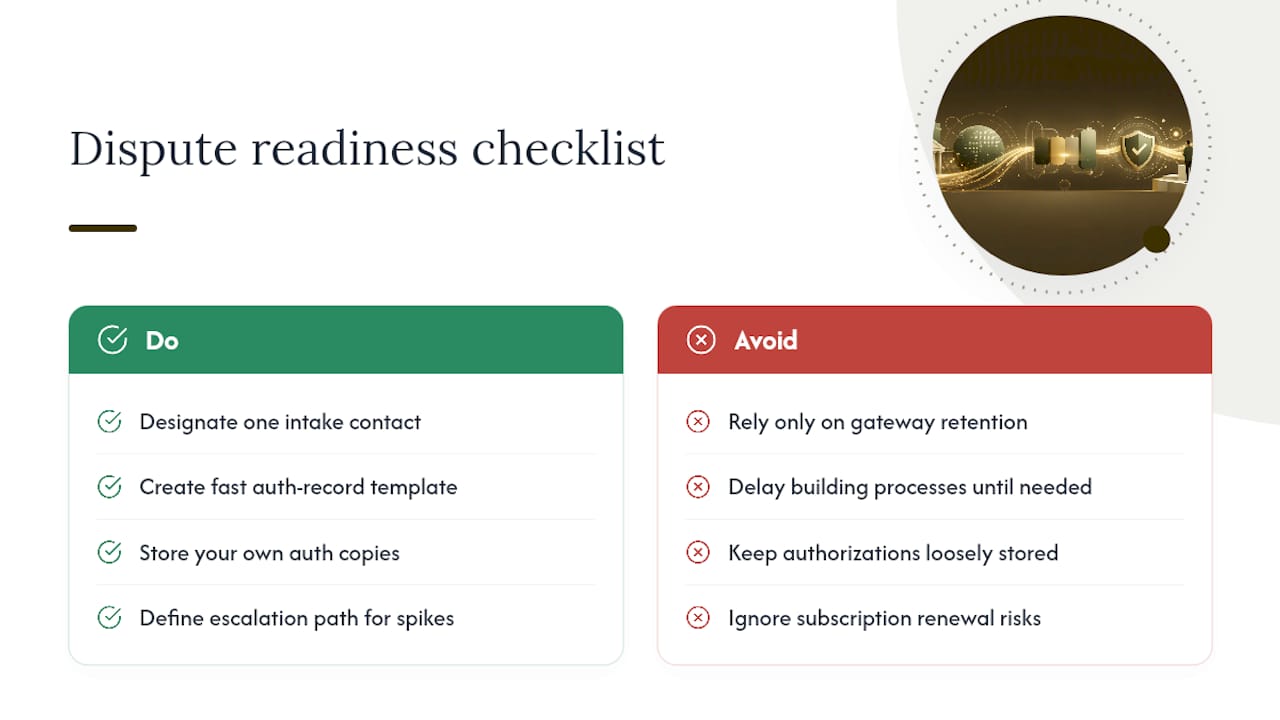
The practical difference between an ACH return and a card chargeback is speed and documentation. Card networks often give merchants a formal representment process with evidence submission. ACH disputes resolve faster and with less back and forth. If a customer disputes a debit as unauthorized, your best defense is having the original signed or recorded authorization on hand immediately, since Nacha rules require you to produce it within 10 days of a request. Businesses that store authorization records loosely, or rely on a third-party gateway’s default retention without confirming their own copy, often struggle to respond in time.
Set up a dispute intake process now, before you need it. That means a single point of contact for incoming return notifications, a template for pulling authorization records fast, and a clear escalation path when a dispute volume spikes for one product line or billing cycle. Businesses running subscription models are especially exposed here, since a forgotten renewal charge is one of the most common sources of an “unauthorized” claim that was technically authorized months earlier.
What Security Standards Protect ACH Transactions?
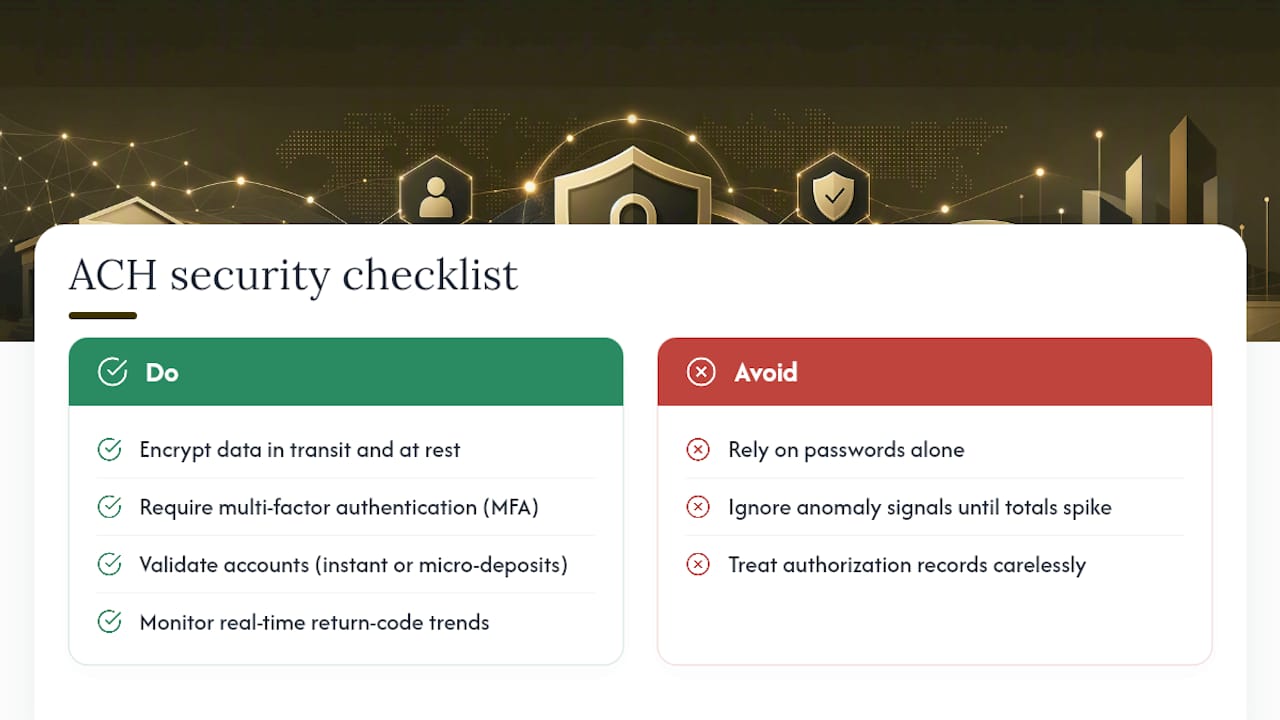
ACH security rests on layers, not a single safeguard. Data in transit between your systems, your bank, and the ACH Operator is encrypted, and reputable payments partners encrypt stored account and routing numbers at rest as well. Multi-factor authentication on your origination platform isn’t optional in practice. If a single compromised password gives an attacker access to your ACH origination dashboard, they can redirect payroll or vendor payments before anyone notices.
Account validation, covered earlier for reducing returns, does double duty as a fraud control. Verifying that a bank account actually belongs to the person claiming it, whether through instant verification or micro-deposits, closes off one of the most common vectors for ACH fraud: using stolen account numbers to originate debits or reroute credits.
Real-time return-code analytics matter here too. Acting on anomaly signals before a threshold breach is operationally cheaper than remediating after the fact, since a spike in unauthorized returns often shows up days before it becomes a full-blown fraud event. Watching that trend line, not just the monthly total, gives your team a head start.
Finally, treat your authorization records with the same care as financial statements. They’re your primary defense in a dispute and a regulatory requirement, and losing them isn’t just an operational gap, it’s a compliance failure waiting to surface at the worst possible time.
Publisher Perspective: Why High-Risk ACH Needs Specialized Underwriting
Most ACH guides treat every business the same way, but return-rate risk, average ticket, and billing cadence vary enormously across industries. Davincipay specializes in high-risk and complex ecommerce businesses, and that specialization exists because generic underwriting misses the real risk drivers in subscription and recurring-billing models.
We help merchants secure reliable processing through domestic and international acquiring relationships, gateways, and fraud prevention tools, because a nutraceutical subscription brand and a telehealth provider face completely different return patterns even though both run recurring ACH debits. Our clients span ecommerce, telehealth, nutraceuticals, and subscription merchants that need underwriting built around their actual billing behavior, not a blanket industry assumption.
— Peter
Need ACH Support Built for High-Risk Merchants?
If your business sits in a category that traditional banks flag automatically, nutraceuticals, telehealth, supplements, subscription commerce, you already know generic ACH setups don’t fit. Davincipay builds ACH and merchant processing around your actual return-rate history and billing cadence instead of a blanket industry ban.

We handle the underwriting conversation, connect you with the fraud prevention and chargeback mitigation tools your vertical actually needs, and get your ACH origination running without the guesswork of piecing together a bank relationship on your own. Supplement and nutraceutical brands can see how this applies to their specific billing patterns on the supplement industry page or the nutraceuticals page. If you’re ready to move forward, apply now and get a real answer on what your onboarding looks like.
Sources
FAQ
How Do I Set Up ACH Payment Processing?
Get an ODFI relationship or a payments partner, build authorization capture into your billing flow, choose a validation method like instant verification or micro-deposits, and pick between a NACHA file integration or an API gateway.
Can I Process ACH Payments Online?
Yes, through the WEB SEC code, which requires account validation and fraud screening under Nacha’s rules for internet-initiated debits.
What Are the Instructions for Making an ACH Payment?
An originator authorizes the transaction, the ODFI submits it to an ACH Operator like the Fed, and the RDFI posts funds to the receiving account, typically within one to three business days or the same day under Same Day ACH.
What’s the Best Way to Receive ACH Payments?
Set up ACH credits through your bank or a payments partner, validate incoming payer accounts when possible, and reconcile daily against your trace numbers to catch discrepancies early. High-risk merchants often benefit from a payments partner that builds monitoring around their specific return-rate history.
How Long Does an ACH Transfer Take to Clear?
Standard ACH clears in one to three business days, while Same Day ACH settles within the same banking day subject to per-entry limits and your bank’s cutoff time.


.webp)
